Call Us Enquire Now
Enquire Now

Enquire Now

×
GeSiM 3D Bioprinting


GeSiM 3D Bioprinting

Precision instruments for 3D bioprinting, microfluidics, and micro-liquid handling – from single hydrogel scaffolds to automated biochip and microarray production. Medispec India is the authorized distributor of GeSiM bioinstruments and microfluidics systems in India, providing local sales, applications, and service support.


7
GeSiM instrument platforms
5–250 °C
Print/extrusion temperature range (BioScaffolder)
0.1 nL–mL
Liquid handling range across the portfolio
< 5 µm
X/Y repeating accuracy (µContactPrinter)


Exclusive Channel Partner

Exclusive Channel Partner

GeSim in India

Industry Experience

Industry Experience

30+ Years Enabling Indian Labs

Pan-India Support

Pan-India Support

Installation, Training, Application & Service Support Across India

Trusted by Leading Labs

Trusted by Leading Labs

Supporting India’s leading research, academic & biopharma institutions


Applications

GeSiM instruments apply one core principle — precise, programmable deposition and manipulation of liquids, gels, and polymers at the micro- and nanoscale — across a family of configurable platforms. From the BioScaffolder's multi-material extrusion to the Nano-Plotter's piezoelectric microarray spotting, each system is built to order from a shared library of tool heads and modules, so labs can start with the configuration they need today and add capability later.

Tissue Engineering

Tissue Engineering

Regenerative Medicine

Regenerative Medicine

Organoid Development

Organoid Development

Drug Testing

Drug Testing

Biomaterials Research

Biomaterials Research


The Technology

One micro-fabrication philosophy, many ways to build biology

Every GeSiM instrument is built around the same core idea – precise, programmable deposition and manipulation of liquids, gels, and polymers at the micro- and nanoscale, configured to your exact application rather than sold as a fixed box.

Multi-Z tool heads

Interchangeable pneumatic and mechanical extruders, piezo pipettes, and mechanical tools mount on independently moving Z-axes, so a single instrument can switch between hydrogels, high-melting polymers, and liquid handling without changing setups mid-run.

Piezoelectric drop-on-demand dispensing

A piezo ceramic actuator bends a silicon diaphragm behind the nozzle on trigger, ejecting a droplet with no valve involved – the same core mechanism scales from single dispensers to 16-channel microarray printers.

CAD-driven, modular software

All GeSiM platforms share a consistent, easy-to-use software environment with hassle-free CAD import, so protocols and tool configurations carry across the BioScaffolder, BioSyntheSizer, Nano-Plotter, and µContactPrinter families.

Configured to order

Nearly every GeSiM system is built from a library of functional modules selected for your application, with post-sales upgrades possible – investment protection as your research evolves.
Products


3D BIOPRINTING

BioScaffolder

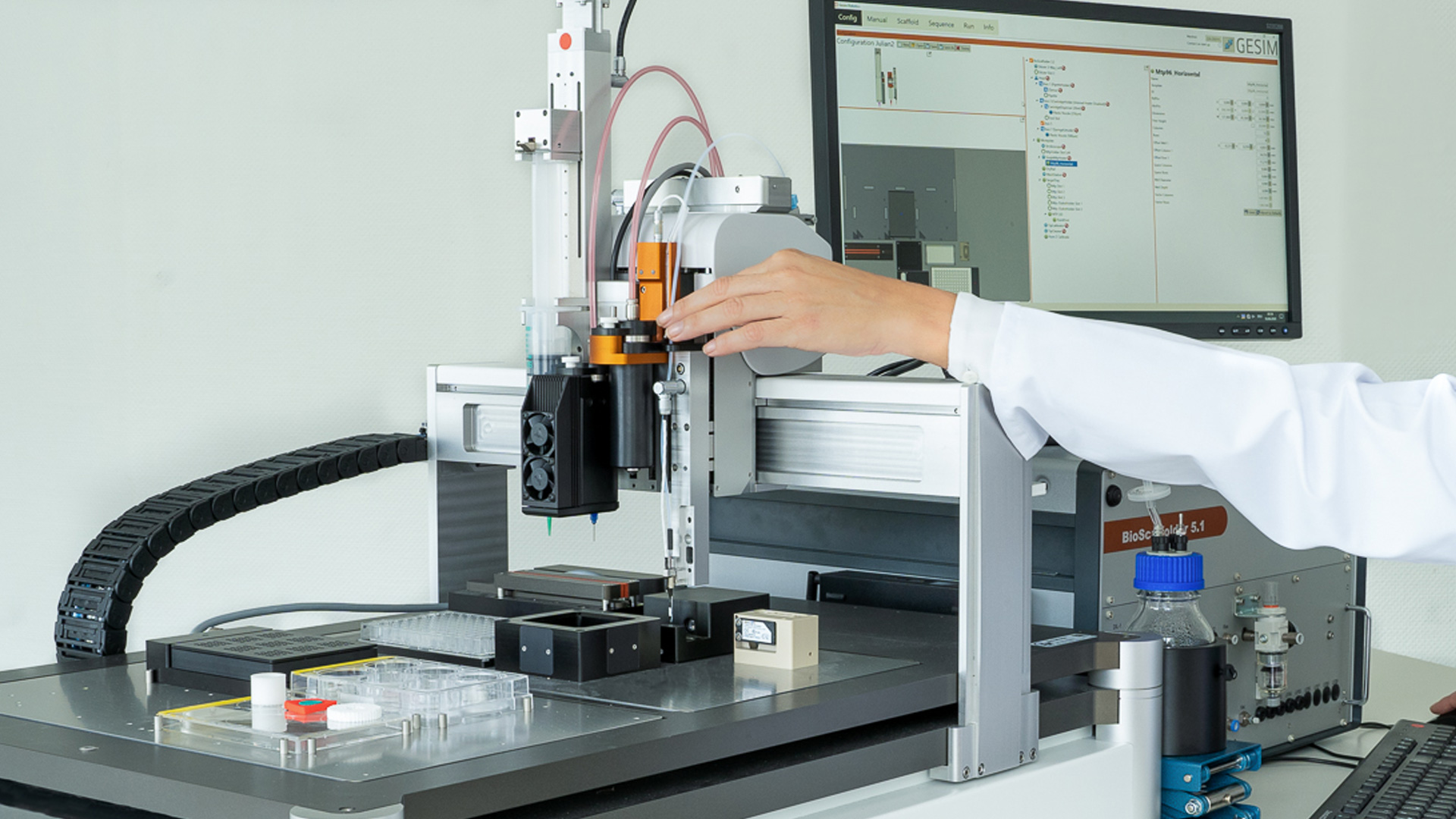
A family of versatile bioprinters for rapid prototyping in 3D cell culture and regenerative medicine. The four drives on the multi-Z tool head handle everything from hydrogels to high-melting polymers, at pressures and temperatures between 5 and 250 °C, without changing tools mid-print. The BS3.3 is ideal for research labs, while the BS5.3 platform adds lightning-fast linear motors for high-throughput, 24/7 operation.


  • Print temperature range from 5–250 °C.
  • Maximum piston extruder pressure of 100 bar.
  • Core/shell nozzle diameters from 100–5,000 µm.
  • Pneumatic and mechanical extruders for both high- and low-temperature materials.
  • Automatic nozzle alignment and substrate height measurement.
  • Micro-liquid handling from picolitre to millilitre for non-contact spotting of cells or drugs.
  • Supports core/shell coaxial printing, melt electrowriting (MEW), UV curing, and gradient mixing.
  • High-temperature piston extruder compatible with custom polymer granules.
  • Fits inside a standard biological safety cabinet (BS3.3/BS3.3 Prime), with larger containment options available for BS5.3.
Best For
  • Bone & Cartilage Scaffolds
  • Multi-material Tissue Scaffolds
  • Melt Electrowriting
  • Core/Shell Bioprinting
  • Custom Implant Prototyping

BioScaffolder combines modular extrusion technologies, precise temperature control, and multi-material processing to support advanced tissue engineering and regenerative medicine research.

BioScaffolder

MICROARRAY PRINTING

Nano-Plotter

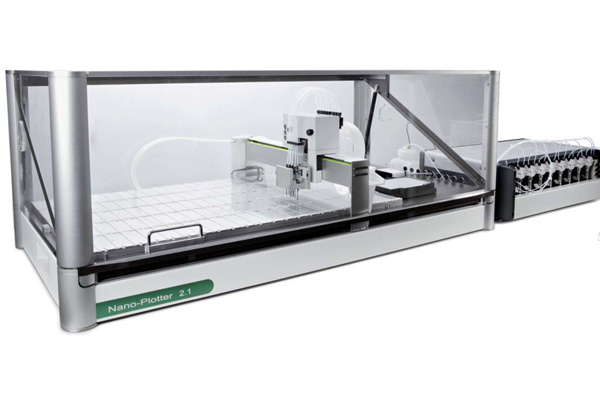
Non-contact piezoelectric microarray printers for diagnostics, protein microarrays, and multiparameter analysis. The benchtop Nano-Plotter NP2.1 and NP2.1/E are established research and production tools for diagnostics (IVD) and beyond, while the Nano-Plotter NP7-HV is an expandable, cascadable mass-production platform for unattended operation.


  • 1–16 independent piezoelectric pipetting tips.
  • Array density exceeding 3,000 spots/cm².
  • Supports 44–96 slides depending on the configuration.
  • Piezoelectric dispensing from 60 pL, with solenoid valve tips from 40–350 nL.
  • Direct sample aspiration from 96- or 384-well microplates.
  • Automatic wash and dry station with optical function testing after every aspiration.
  • “Spot-On-the-Fly” mode reduces printing time by up to 50% for identical-object runs.
  • Camera-based optical target recognition for precise alignment to biosensors and microfluidic cartridges.
  • NP7-HV scales with tray stackers supporting up to 540 slides or 60 SBS plates for unattended production.
Best For
  • DNA Microarrays
  • Protein Microarrays
  • Point-of-Care Diagnostics
  • Reverse Phase Protein Arrays
  • Electrical Biochip Loading
  • Multiplexed 96-Well Assays

Nano-Plotter delivers highly accurate, non-contact dispensing for research and production environments, enabling reliable fabrication of high-density diagnostic and protein microarrays.

Nano-Plotter

MICROFLUIDIC PROTOTYPING

MicCell

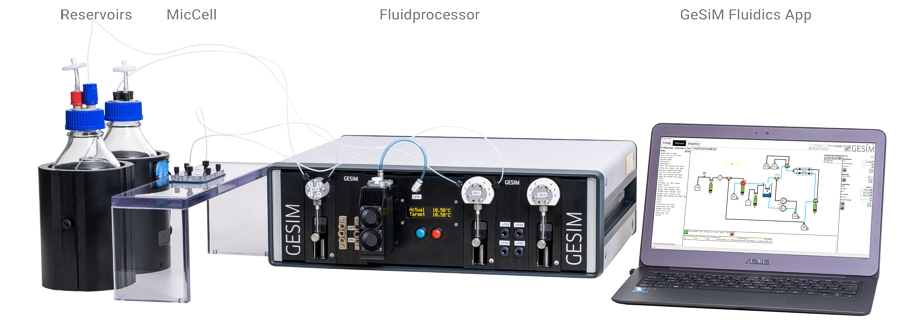
Microfluidics on the microscope stage – a customizable tool kit for micro- and cell biology. MicCell combines an affordable PDMS casting process with a convenient mechanical setup for rapid channel-plate replacement, while optional foil-based flow cells provide a disposable, multi-layer solution for point-of-care and microfluidic applications.


  • Standard channel plate sizes of 22×22 mm, 22×50 mm, and 25×75 mm.
  • Flow sensor measurement range from 0–100 µL/min.
  • Disposable PDMS channel plate chips for fast replacement between experiments.
  • Do-it-yourself casting set for custom channel layouts from CAD-derived master chips.
  • Foil-based flow cells for disposable, multi-layer microfluidic and point-of-care applications.
  • Optional FluidProcessor with automated syringe pumps, valves, pressure regulators, and sensors.
  • Cascadable thermocalorimetric flow sensor supporting up to four channels per controller.
Best For
  • Micro-Reaction Assays
  • Hybridization Assays
  • Drug Screening
  • Biosensor Development
  • Biofilm Studies
  • Concentration Gradient Generation

MicCell provides a flexible microfluidic platform for live-cell studies, biosensor research, and automated flow-based experiments with customizable channel designs and integrated fluid control.

MicCell

PICO- & NANOLITRE DISPENSING

Nanolitre Dosage

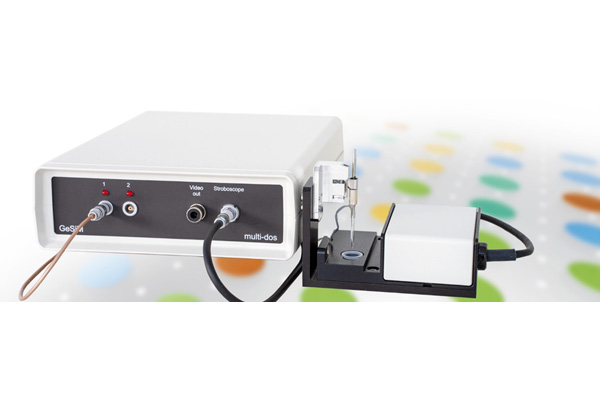
Piezoelectric dispensers designed for easy integration into custom laboratory and industrial setups. GeSiM Nanolitre Dosage systems use a drop-on-demand principle, where a piezo actuator ejects droplets without valves, enabling highly precise dispensing of low-viscosity liquids with optional heated versions for expanded application flexibility.


  • Drop volume range from 0.1–1.1 nL (PicPIP to SPIP).
  • Maximum dispensing frequency of 500–1,000 Hz.
  • Supports up to 6 independently controlled dispensers with the multi-dos controller.
  • SPIP (0.6–1.1 nL) and PicPIP (0.1–0.2 nL) dispensers support different liquid viscosity ranges.
  • Multi-dos controller features a serial interface with API support for custom software integration.
  • Optional stroboscope camera enables droplet visualization and inspection.
  • Heatable dispenser shells extend compatibility with glues, oils, and higher-viscosity liquids.
  • Cartridge reservoirs allow dispensing of larger liquid volumes than the built-in microlitre reservoir.
Best For
  • Adhesive Dispensing
  • UV-Curable Resins
  • Microdroplet Mixing
  • Collision Studies
  • Nanolitre Pipetting
  • Biochemical Liquids

Nanolitre Dosage delivers accurate, repeatable drop-on-demand dispensing for research, diagnostics, electronics, and industrial applications where precise nanolitre liquid delivery is essential.

Nanolitre Dosage

LIQUID HANDLING & SYNTHESIS

BioSyntheSizer

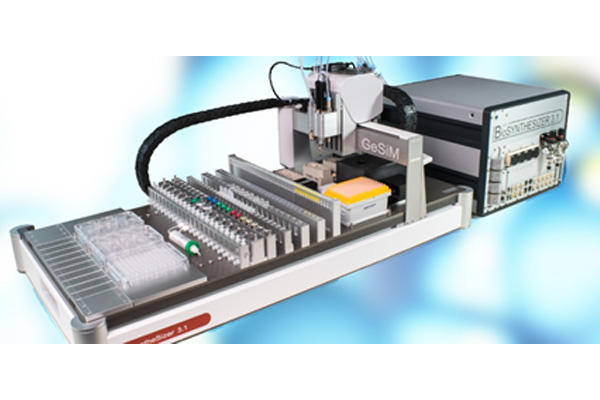
A liquid handling robot and more, designed for complex laboratory automation at low-volume scale. The compact BioSyntheSizer combines automated pipetting with interchangeable tools and GeSiM’s piezoelectric dispensing technology, providing a configurable platform for synthesis, liquid handling, and laboratory workflows.


  • Up to 7 independently moving Z-axes on the tool head.
  • Liquid handling range from sub-nL to mL.
  • Reactor temperatures up to 150 °C with pressures up to 8 bar.
  • Supports interchangeable tools including piezoelectric pipettes, powder pipettes, titration pipettes, vacuum grippers, cap openers, Z-sensors, and UV lamps.
  • Quick-connect racks for tubes, vials, microtitre plates, and reaction vessels.
  • Configured to order for collagen, hydrogels, radiopharmaceutical tracers, and other biopolymer synthesis workflows.
  • Post-sales tool upgrades available without major hardware modifications.
  • Validated for hydrogel synthesis, peptide array chemistry, and collagen bioink preparation for 3D bioprinting.
Best For
  • Hydrogel Synthesis
  • Biopolymer Synthesis
  • Peptide Array Chemistry
  • Collagen Bioink Preparation
  • Radiosynthesis Automation

BioSyntheSizer provides a highly configurable automation platform for precision liquid handling, chemical synthesis, and advanced laboratory workflows with modular tool integration.

BioSyntheSizer

SURFACE PATTERNING

µContactPrinter

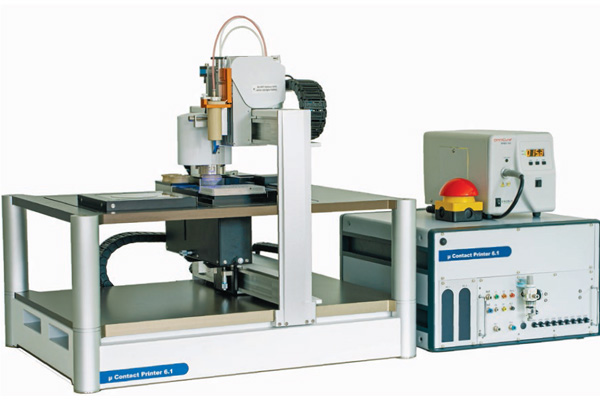
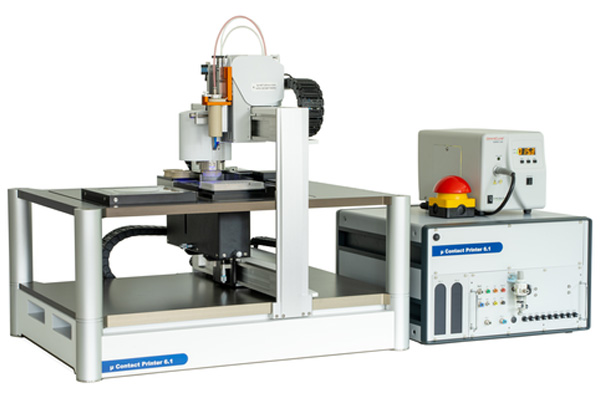
Instruments for microcontact printing (µCP) and nanoimprint lithography (NIL), enabling the creation of highly reproducible two- and three-dimensional micro- and nanostructures. Proprietary stamping technology, precise Z-drive control, and pneumatic actuation ensure accurate pattern transfer without requiring vibration-damping tables.


  • Supports stamp sizes up to 20 × 20 mm (µCP4.x).
  • Compatible with substrates up to 152 mm (6″) (µCP6.x).
  • Better than 5 µm X/Y repeating accuracy.
  • Minimum structure size down to 100 nm using custom masters.
  • Integrated XYZ stage, camera, stamp holder, and UV lens head.
  • Linear-motor platform enables zero-spacing multiple imprinting.
  • µCP Core provides a compact, microscope-mounted solution.
  • Includes PDMS casting station and vacuum-assisted de-tooling for high-aspect-ratio NIL structures.
Best For
  • Microneedle Arrays
  • Nanoplasmonic Biosensors
  • Cell Patterning
  • Nanoimprint Lithography
  • Single-Cell Assays

µContactPrinter delivers highly precise microcontact printing and nanoimprint lithography for advanced research, biosensor fabrication, and micro- and nanostructure development.

µContactPrinter


Which GeSiM Instrument Is Right for You?

Compare GeSiM’s portfolio of microfabrication platforms to find the right solution for your workflow. From 3D bioprinting and microarray spotting to nanolitre dispensing, liquid handling, and surface patterning, every system is engineered for precise, programmable processing of biological materials.


Application / Instrument BioScaffolder Nano-Plotter MicCell Nanolitre Dosage BioSyntheSizer µContactPrinter
Core Function 3D bioprinting / extrusion Microarray spotting Microfluidic flow cells Piezo droplet dispensing Liquid handling / synthesis Surface patterning (µCP/NIL)
Volume Range pL–mL 60 pL–350 nL Flow-based (0–100 µL/min) 0.1–1.1 nL/drop Sub-nL–mL N/A (surface transfer)
Temperature Range 5–250 °C Ambient (heatable tips optional) Ambient Ambient (heatable option) Up to 150 °C Up to 100 °C (substrate holder)
Configurable / Modular
Automation / 24-7 Capable ✓ (BS5.3) ✓ (NP7-HV) With FluidProcessor With multi-dos -
Typical Use Case Tissue scaffolds, organoids Diagnostic & protein arrays Flow-based cell/biosensor assays Custom nanolitre integration Biopolymer synthesis Micro/nanostructure patterning


Key Capabilities

Advanced bioprinting capabilities for biomaterials, tissue engineering, microarray fabrication, and automated research workflows.


Multi-material extrusion – 5–250 °C, core/shell and MEW printing

Multi-material extrusion – 5–250 °C, core/shell and MEW printing

Piezoelectric dispensing scaling from picolitres to millilitres

Piezoelectric dispensing scaling from picolitres to millilitres

High-density microarray fabrication – 3,000+ spots/cm²

High-density microarray fabrication – 3,000+ spots/cm²

Sub-5 µm surface patterning down to 100 nm structures

Sub-5 µm surface patterning down to 100 nm structures

Configurable synthesis and liquid handling to 150 °C / 8 bar

Configurable synthesis and liquid handling to 150 °C / 8 bar

Automation-ready for unattended 24/7 production

Automation-ready for unattended 24/7 production


Medispec Scientific Support

Instrument Installation & Validation
Application Training
Workflow Optimization
Preventive Maintenance
AMC Support
AMC Support
Technical Troubleshooting
Assay Consultation
Assay Consultation
AMC Support
AMC Support

Trusted Across Advanced Research Laboratories

Used by leading institutions driving scientific progress across India and globally.

  • Biotech Companies
  • Pharmaceutical Organizations
  • Translational Research Centers
  • Academic Institutes
  • Diagnostics Laboratories
Across Leading Research Areas
  • Oncology
  • Immunology
  • Cardiovascular
  • Cell Therapy
  • Tissue Engineering
  • Regenerative Medicine
  • Drug Testing
  • Organoid Development

Frequently Asked Questions

Which GeSiM instrument should I start with if I’m new to 3D bioprinting?

The BioScaffolder BS3.3 or BS3.3 Prime is the recommended starting point. Both are compact, fit inside a standard biological safety cabinet, and use the same intuitive software shared across the BioScaffolder family, making it easy to scale to the BS5.3 platform as your research grows.

What’s the difference between the BS3.3 and BS5.3 BioScaffolder platforms?

 Both platforms use the same multi-Z tool head architecture and software. The BS5.3 adds high-speed linear motors for continuous 24/7 operation, while the BS5.3/E offers a larger print area for bigger scaffolds and additional tool configurations.

When do I need a Microarray Printer instead of a standard liquid handler?

Choose the Nano-Plotter when your application requires non-contact dispensing of picolitre- to nanolitre-sized droplets with extremely high precision and array densities exceeding 3,000 spots/cm², such as DNA or protein microarrays, biosensor functionalization, and multiplexed assays.

What’s the difference between the Nano-Plotter NP2.1 and NP7-HV?

The NP2.1 and NP2.1/E are compact benchtop systems for research and production, while the NP7-HV is an expandable, high-throughput production platform with inline workstations and tray stackers for unattended, large-scale microarray manufacturing.

Can GeSiM’s Nanolitre dispensers be integrated into my own instrument?

Yes. GeSiM’s piezoelectric Nanolitre dispensers are designed for easy integration into custom instruments and workflows. The multi-dos controller supports up to six independently controlled dispensers and provides an API for seamless software integration.

What’s the difference between the BioSyntheSizer and standard liquid handling robots?

 BioSyntheSizer combines conventional liquid handling with picolitre piezoelectric dispensing, interchangeable laboratory tools, and up to seven independently moving Z-axes. This makes it ideal for advanced workflows such as hydrogel synthesis, peptide array chemistry, collagen bioink preparation, and laboratory automation.

When would I need microcontact printing (µCP) instead of microarray spotting?

Choose the µContactPrinter when your application requires nanoscale surface patterning rather than spot deposition. It is ideal for microneedle fabrication, nanoplasmonic biosensors, extracellular matrix patterning, and nanoimprint lithography, where feature sizes can reach the nanoscale.

Get the Right 3D Bioprinting System for Your Lab

Medispec India is the exclusive channel partner of GeSiM laboratory equipment,  providing local sales, installation, certification, and service support.